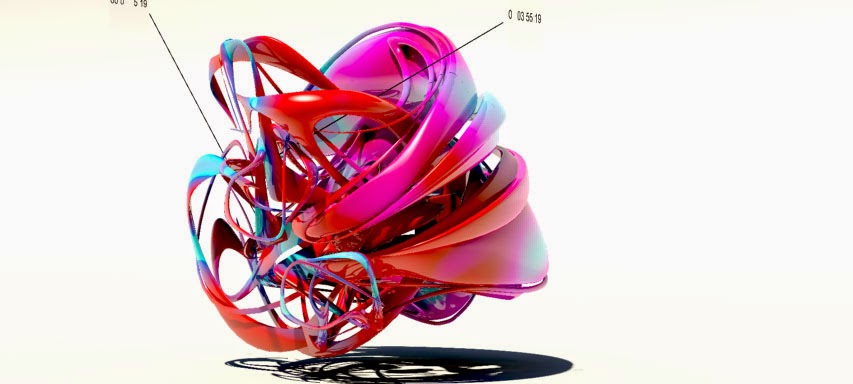
Strategies and concepts for new synthetic forms and digital output
David Hall "X_System15"2009
Course Description
This course will be in three sections every semester.
Generation, Process and output. Each semester will lead to progressively more complex and refined approaches to fabrication and construction. The objective is to teach students the theory, production techniques and process of digital form and fabrication in a variety of media and disciplines.
Part one of every semester will deal with “Theory and development”. This will include digital topology and surfacing techniques using meshing tools of various types.
Part Two Digital process and construction techniques.
Part Three will focus on the physical process of digital output in three specific forms.
----------------------------------------------------------------------------------------------------
One - research Strategies for visual form development
David Hall "Meme Cells"2011
Preface
Developing your own personal visual style has always been a goal of masters degree art students. One of the traditional undergraduate techniques of achieving this is to study other artists, designers and contemporary/historical movements. For postgraduate students however we must employ a more diverse and sophisticated strategy. So in effect you need to choose and define an area within which you can research and explore. And by research and explore I mean, drawing, reading and photographing the subject, NOT just downloading images. Areas and subjects that could be useful ( I am NOT saying you need to use any of these, you should choose your own ) could be “science and biology structure”, “natural forms and systems”, generative and algorithmic dynamics”, “fluid mechanics”, etc.
By research I mean, if you find or take photographs of a given subject you need to be able to analyse the images to define what you are interested in.
Stage One - Part A - “Define”
Please choose an area or group subject title that you will read and research.
This initial stage should be uploaded to your blog. Just uploading a downloaded image is unacceptable. I expect to see written analysis.
Stage One - Part B - “Explore”
Here you will develop your theme by photographing, drawing and written analysis.
Stage One - Part C - “Consolidated”
With the preliminary work done it's time to specify your research are practically, by this I mean “how can this subject be conceptualized in order to use it for further development with respect to three dimensional output.
----------------------------------------------------------------------------------------------------
Two - Digital form finding and low resolution Printing
David Hall "Body Test"2010
Preface
Digital output in the form of 3D printing has been the driving force behind many of the recent design explorations of the past decade. The dream of direct computer controlled construction is finally here. At last we are free of the development to manual construction paradigm. The implications of this revolution for artists and designers could not be more profound. Its a revolution on the scale of the development of the internet or computing itself.
This is the profound liberation we all talked about for a few decades, now its here its time to get with the program so to speak.
As with all revolutions (think photography then film) understanding the basic principles can help with your future understanding of the process. As such we will start with low resolution laser cutting. This is in effect the fundamentals of digital fabrication. using laser cutting practice can be incredibly useful for all artists and designers no matter what the project they are working on.
Section Two - Part A - “Meshes and Form Finding”
Here we will explore basic form development inside your chosen 3D application, this does not need to be specific, it could be Maya, 3DS, or Cinema 4D its upto you.
We will use the tried and tested distortion select method.
Section Two - Part B - “Slicing Mechanics”
Once we have the selected model now we will begin the process of getting it ready for print. As this is a laser cut we will use either a straight slice method or an intersection method. This will depend on your model.
Section Two - Part C - “Printing, Cutting and Assembly”
This is the final stage of this section. Once we have printed we will assemble.
----------------------------------------------------------------------------------------------------
Three - Organic Structure and Hi resolution Rapid Prototyping
David Hall "Body Home"2009
Preface
Computational space and the new frontier. The reason why aesthetically design has and will change so much is that from now on much of design exploration will not be shackled by 20th century construction and manufacturing techniques and process. A great deal of contemporary architecture and design schools have a digital lab specifically to explore the now aesthetic and visual horizons that rapid prototyping is opening up. As soon RP machines will probably be embedded in each home or office, it is easy to envisage a consumer environment where you would download and print your mobile phone for example. This would mean an end to the retail environment as we now know it. But the real question is “as designers what will this new future look like with all its complexity and flexibility. This is what we will explore here.
Section Three - Part A - “Meshes and Form Finding V1.2”
This is the longest part of the semester ( I estimate about 7 weeks ). Here as the resolution and build width of the printer is very fine you can explore the potential of the machine through complexity on achievable by computer and printer.
Section Three - Part B - “Printing Mechanics”
I will go through the process of making forms and models “print ready”. This means looking at construction topology and closed meshes.
There are a number of ways of technically achieving this, I will detail step by step the methodology and programs we need to utilize.
Exhibition and Photographic documentation.
If all goes well I would like to org anise a small show showing the process from low resolution to hi res prints. We will also need to do professional photography documenting the whole process and results.
----------------------------------------------------------------------------------------------------
NOTES -
Morphic Strategies Green Growth lab
Dave Hall / Roger Pitiot
Bio_
Zoo_
Ana_
Data_
_____ Morphic
Preface
There are quantum changes taking place in the fields of manufacturing, Construction, Design, Architecture and the use of integrated computing as a driving force of these paradigm shifts. The seeds of these changes can be seen in embryonic form today in the form of the generative and procedural approach to design and architecture as well as new forms of realization such as rapid prototyping and digital fabrication.
The visual form, nature and aesthetic of these new approaches are experiments in trying to define the new aesthetics for these new territories.
Areas of Research
Generative and Procedural computing
Aesthetic development for new frontiers
Digital Fabrication and construction
Natural systems and integration
Projects and Measurable Objectives
Conference Presentation and attendance
Exhibition